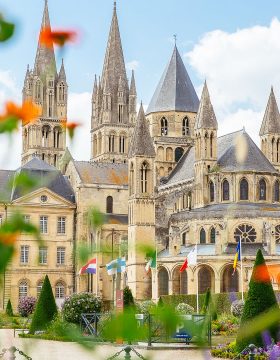
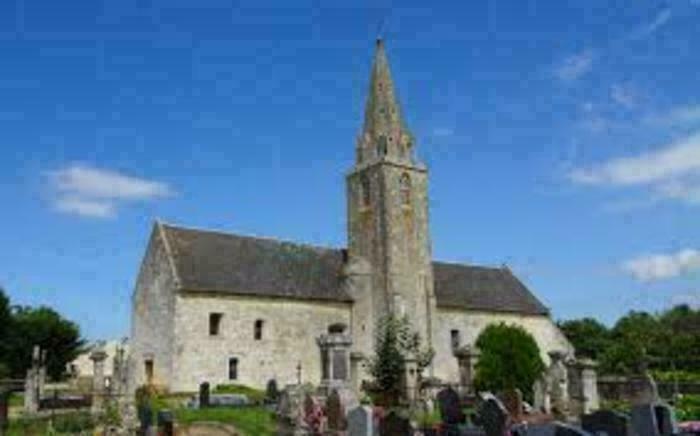
Parts of the nave are Romanesque. The bell tower, built in the 16th century, features pointed arch windows in its upper section. The spire, adorned with four pinnacles, is made of limestone.
Excavations carried out between 1999 and 2001 revealed: - graves, some of which are thought to date from the Bronze or Iron Ages, but most of which are from the modern era; - part of the structure was Romanesque or pre-Romanesque.(I.S.M.H. 1927). - a coat of arms hidden beneath the plaster on the south and west walls, bearing the arms of the Croismare family, who owned the castle from 1628 to 1768. - The finest discovery was that of the statue of St Peter. It was found buried in the ground outside the church, near the south wall of the nave. - A Second Empire-style Italian mosaic (terrazo alla veneziana). The ancient paving stones visible beneath the platform – beneath the grey plaster and cement of the nave walls – reveal: large stones on the south wall, and a north wall built entirely using the OPUS SPICATUM (fishbone) method, a construction technique used from the Romanesque period until the end of the 11th century, both in churches in the region, such as those at Anisy and Cambes-en-Plaine, and in major cathedrals such as Durham in the north of England. This wall is composed of limestone slabs and, more rarely, flint, and has undergone numerous alterations with the creation of openings that were subsequently enlarged or blocked up. This wall originally formed a quadrilateral measuring approximately 12m by 6m, which was extended by 3m at the rear of the church in the 12th century. (Note the difference in colour, which is due to a different proportion of clay.) The external buttress at the junction of the two structures is thought to be typical of the 11th century.