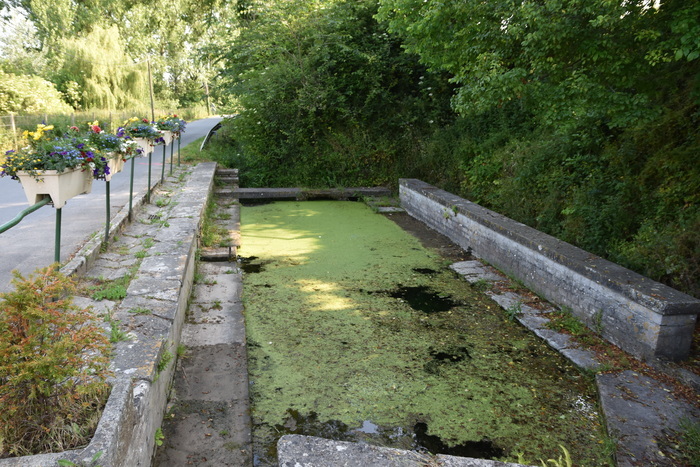
A charming reminder of life in days gone by, when social life was thriving. Washhouses became widespread thanks to the 1851 Act, which encouraged towns and villages to establish them.
The Secqueville washhouse is situated on a branch of the River Thue, a tributary of the Seulles. It also has a chimney for producing the ash needed for bleaching.
Information panels trace the history of washhouses in France and help visitors understand how the Secqueville washhouse in Bessin worked.
Washhouses have a rich and fascinating history, closely linked to the evolution of hygiene practices, social life and urban planning in Europe, particularly in France. Here are the key stages in their history:
Origins and development
Antiquity: The first public washhouses appeared in ancient civilisations (Rome, Greece), often in the form of basins fed by springs or aqueducts. They were used both for washing clothes and for personal hygiene.
The Middle Ages: With the fall of the Roman Empire, washhouses gradually disappeared. Laundry was washed in rivers, fountains or drinking troughs, which posed problems of hygiene and pollution.
The rise of public washhouses (17th–19th centuries)
17th century: In France, the first royal decrees encouraged the construction of washhouses to improve public hygiene and prevent epidemics.
19th century: This was the golden age of washhouses. The French law of 1851 required every municipality with more than 500 inhabitants to have a public washhouse. This was the golden age of washhouses. During the Second Empire, thousands of washhouses were built in towns and villages. They became places where women socialised, where washerwomen gathered to work and chat.
Architecture: Washhouses were often covered, with stone or concrete basins and a roof to protect the washerwomen from the elements. Some were fed by natural springs, others by mains water supplies.
Decline and heritage (20th–21st centuries)
Early 20th century: The arrival of mains water in homes and washing machines rendered washhouses obsolete. Many were abandoned or demolished.
1970s–2000s: A growing awareness of their heritage value led to the restoration of many washhouses, which became symbols of rural and industrial heritage.
Today: Washhouses are often places of remembrance, tourist attractions or cultural venues. Some are still used for local events or festivals.
Symbolism and heritage
A place of community life: Washhouses were much more than just places for washing. They were spaces for female solidarity, where women exchanged news, advice and, at times, gossip. They played a major social role in villages.
Heritage: In France, many wash houses are listed or designated as historic monuments, reflecting their importance in social and architectural history.